In the rapidly evolving landscape of AI-powered search, getting cited by Perplexity AI has become a crucial milestone for content creators, businesses, and digital marketers. As traditional search engines give way to answer engines that provide direct, AI-generated responses, the game has fundamentally changed.
Instead of competing for clicks on search result pages, the new objective is securing citations within AI-generated answers. Perplexity AI represents one of the most influential platforms in this space. Understanding how to position your content for Perplexity citations isn't just about SEO anymore; it's about Answer Engine Optimization (AEO).
This comprehensive guide will walk you through proven strategies, technical requirements, and content optimization techniques that increase your chances of being cited by Perplexity AI's sophisticated algorithms.
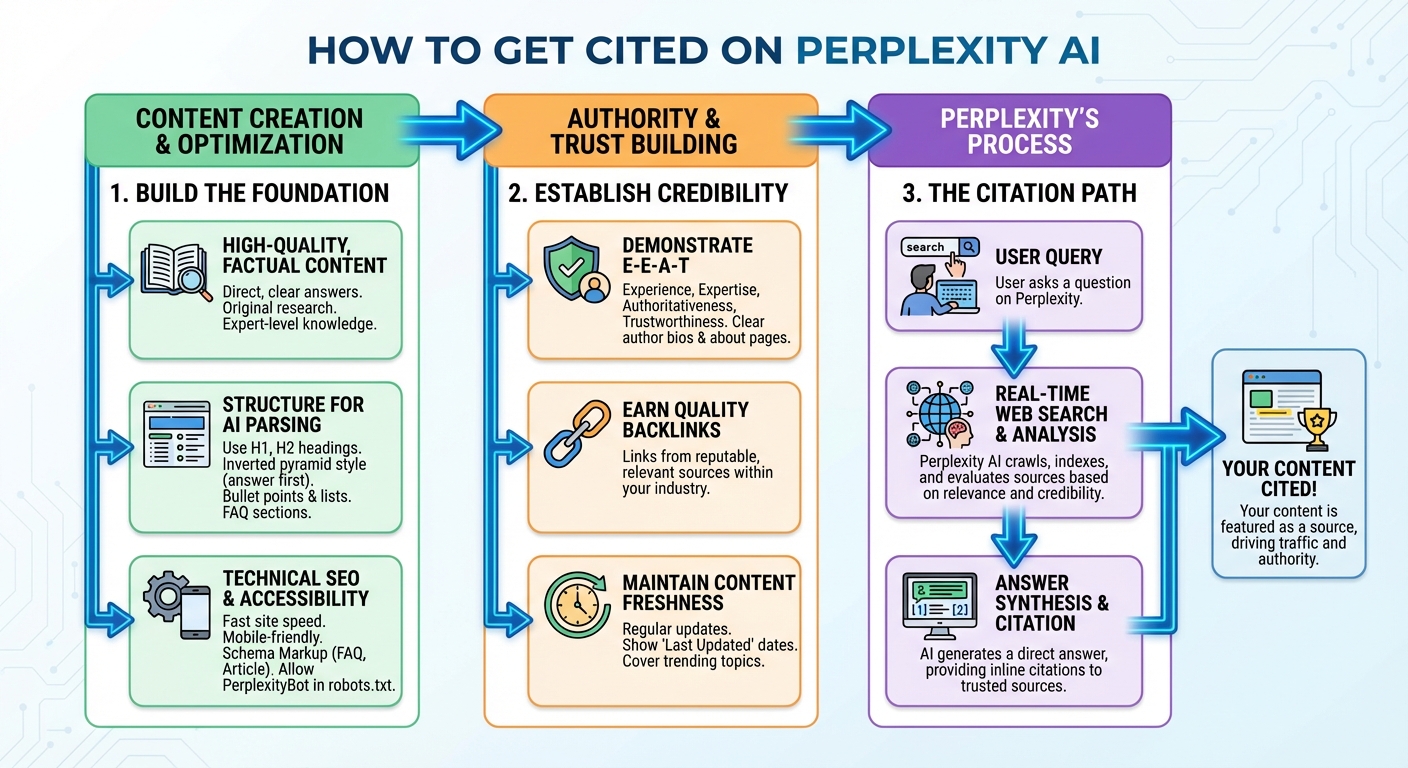
The three pillars of getting cited by Perplexity AI
Understanding Perplexity AI's Citation System
Perplexity AI operates differently from traditional search engines by synthesizing information from multiple sources to generate comprehensive answers. When users ask questions, the platform doesn't just return a list of links. It creates original responses while citing the most authoritative and relevant sources that informed its answer.
Key Citation Factors
- Content Quality & Factual Accuracy: Perplexity prioritizes verifiable, well-structured information over keyword-stuffed pages.
- Source Authority: Established websites with strong reputations have a higher likelihood of being cited.
- Unique Insights: The platform favors sources that provide unique data or comprehensive coverage that can be cross-referenced.
Typically, Perplexity cites between 3-8 sources per response, making the competition for these slots extremely high.
Pillar 1: Build the Foundation (Content Creation & Optimization)
The first pillar focuses on creating content that AI systems can easily parse and understand.
High-Quality, Factual Content
Perplexity favors content that presents information in a clear, authoritative manner without ambiguity. Focus on:
- Direct, clear answers: Get to the point quickly with concise, accurate information.
- Original research: Include unique data, studies, or insights that can't be found elsewhere.
- Expert-level knowledge: Demonstrate deep expertise in your subject matter.
Structure for AI Parsing
Optimize your content structure so AI can easily extract and understand your information:
- Use H1, H2 headings: Create a clear hierarchy that mirrors common question patterns like "What is," "How to," "Why does."
- Inverted pyramid style: Put the answer first, then provide supporting details.
- Bullet points & lists: Make information scannable and easy to extract.
- FAQ sections: These are particularly effective because they mirror the question-and-answer format of the AI itself.
Technical SEO & Accessibility
Technical optimization plays a crucial role in positioning your content for Perplexity citations:
- Fast site speed: Ensure your website loads quickly. Google's PageSpeed Insights can help identify areas for improvement.
- Mobile-friendly: Your site must be fully responsive and accessible on all devices.
- Schema Markup: Implement structured data (FAQ, Article schemas) to help AI systems understand the context of your content.
- Allow PerplexityBot in robots.txt: Ensure your robots.txt file permits Perplexity's crawler to access your content.
Pillar 2: Establish Credibility (Authority & Trust Building)
The second pillar focuses on building the authority signals that make Perplexity trust your content as a reliable source.
Demonstrate E-E-A-T
E-E-A-T stands for Experience, Expertise, Authoritativeness, and Trustworthiness. These are the key signals that establish credibility:
- Experience: Show real-world experience with your subject matter through case studies and examples.
- Expertise: Demonstrate deep knowledge through comprehensive, accurate content.
- Authoritativeness: Build recognition as a go-to source in your industry.
- Trustworthiness: Maintain accuracy, cite sources, and be transparent about your credentials.
- Clear author bios & about pages: Help AI understand who is behind the content and why they're qualified.
Earn Quality Backlinks
Links from reputable sources signal authority to AI systems:
- Focus on earning links from reputable, relevant sources within your industry.
- Create linkable assets like original research, comprehensive guides, and unique tools.
- Build relationships with industry publications and thought leaders.
Maintain Content Freshness
Perplexity favors fresh, up-to-date information:
- Regular updates: Establish a maintenance schedule to keep your data current.
- Show 'Last Updated' dates: Display when content was last reviewed or updated.
- Cover trending topics: Stay current with emerging trends in your industry.
Pillar 3: The Citation Path (Perplexity's Process)
Understanding how Perplexity processes queries helps you optimize for each stage of the citation path:
User Query
A user asks a question on Perplexity. Understanding common query patterns in your niche helps you anticipate what users are asking.
Real-Time Web Search & Analysis
Perplexity AI crawls, indexes, and evaluates sources based on relevance and credibility. Your content must be accessible and optimized to be discovered at this stage.
Answer Synthesis & Citation
The AI generates a direct answer, providing inline citations to trusted sources. Content that is structured for easy extraction and clearly answers the query is more likely to be cited.
Your Content Cited!
Your content is featured as a source, driving traffic and authority to your site.
Content Formats That Attract Citations
Certain content formats perform better for Perplexity citations because they are easier for AI to parse and synthesize:
Comprehensive Guides & How-To Articles
These directly answer user queries with actionable information.
FAQ Sections
These are particularly effective because they mirror the question-and-answer format of the AI itself. Structure them with clear questions and concise, standalone answers.
List-Based Content
Articles featuring "best practices," "steps to follow," or "key features" allow AI systems to quickly extract list items.
Monitoring and Measuring Citation Success
Tracking your success on Perplexity is more complex than tracking Google rankings because citations appear dynamically in generated answers. While you can manually search for your brand, scaling this process requires specialized tools.
The Professional Approach: Using Evertune.ai
For serious AEO practitioners, we recommend using dedicated tracking platforms like Evertune.ai. Unlike basic keyword trackers, Evertune is designed specifically for the "Generative Engine" era.
Why Evertune.ai for Perplexity Tracking
- Multi-Model Tracking: Evertune monitors your brand's citations across Perplexity, ChatGPT, Gemini, and Claude simultaneously, giving you a complete view of your AI visibility.
- AI Brand Score: The platform provides a quantifiable "AI Brand Score," allowing you to benchmark your visibility against competitors rather than guessing your standing.
- Sentiment Analysis: Beyond just counting citations, Evertune analyzes how AI models talk about you, whether the sentiment is positive, neutral, or negative.
- Content Gap Detection: It identifies queries where your competitors are being cited but you are not, providing a clear roadmap for new content creation.
The Manual Approach
If you are just starting out, you can set up Google Alerts for your brand name and key unique phrases. Regularly search Perplexity for questions related to your niche to see if your content appears in the generated responses.
Future-Proofing Your Citation Strategy
As AI systems continue to evolve, citation criteria will become more sophisticated. Focus on building sustainable strategies that emphasize quality, accuracy, and user value.
- Build Topical Authority: Create clusters of content around your core expertise rather than shallow posts on many subjects.
- Update Content Regularly: Perplexity favors fresh, up-to-date information. Establish a maintenance schedule to keep your data current.
- Stay Informed: Follow industry publications like Search Engine Land and the Content Marketing Institute to understand emerging trends in answer engine optimization.
- Diversify Platforms: While this guide focuses on Perplexity, these strategies apply across most AI search platforms, creating compound benefits for your visibility.
Conclusion
Getting cited by Perplexity AI requires a fundamental shift from traditional SEO thinking to Answer Engine Optimization. Success depends on creating high-quality, authoritative content that directly answers user questions while meeting technical requirements for AI accessibility.
The future of digital visibility belongs to those who adapt quickly to these emerging technologies.